
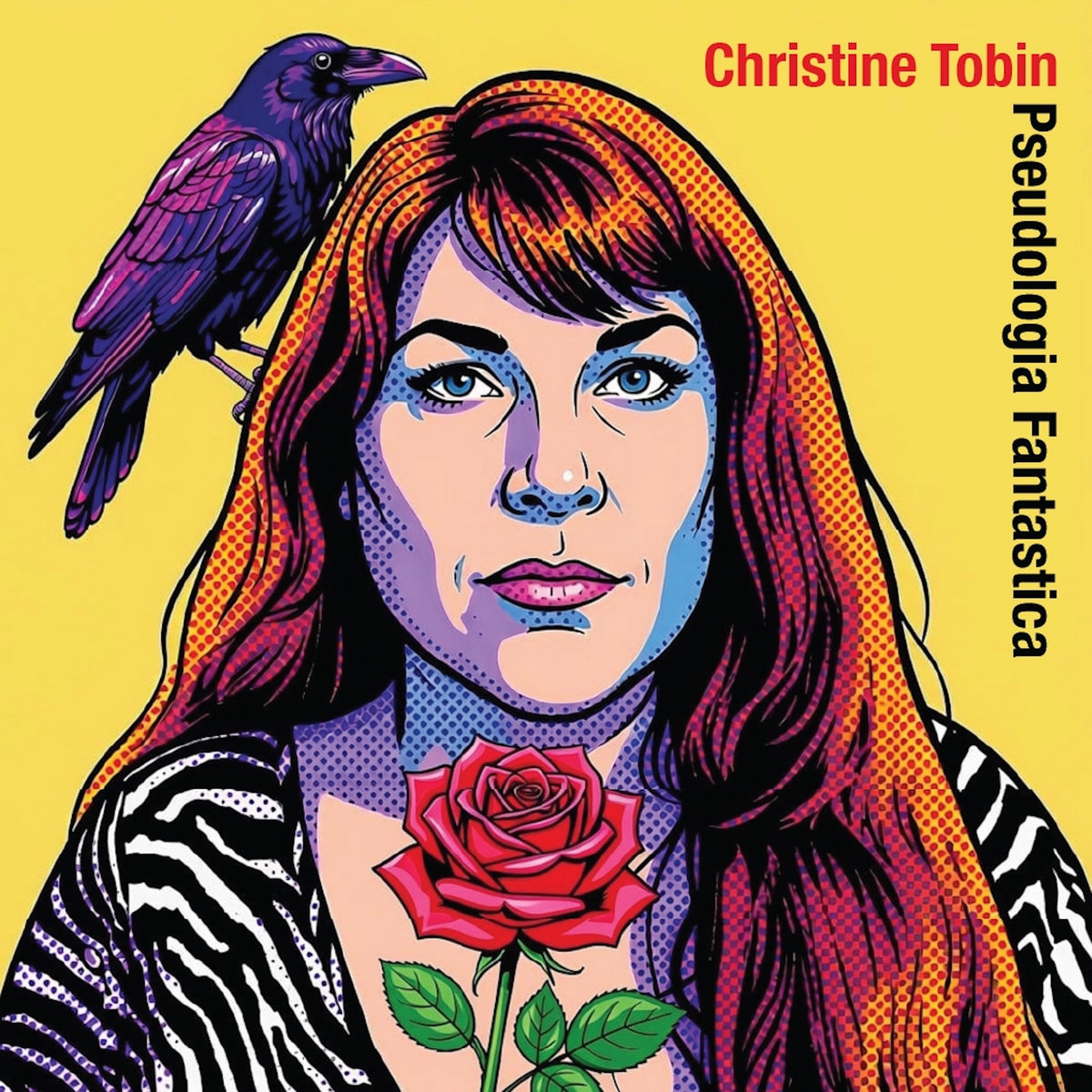
The latest release from critically acclaimed vocalist Christine Tobin is a gripping yet challenging look at how we interact with media, language and the truth in an increasingly outlandish and pernicious socio-political landscape. Pseudologia Fantastica – pathological liar – is an 18-piece concept album which paints bold pictures through electronic soundscapes, inventive spoken word, and masterful vocals. The record also features British cellist Kate Shortt as well as Christine’s long-time collaborator and partner, guitarist Phil Robson, who also produced and mixed the album.
Tobin is certainly to be counted among Ireland’s most significant jazz exports. With decades spent building a career in London and New York, the Dublin-born singer has scooped up ample awards and critical adoration. Her work never seems to sit still; each new project brings new pathways and techniques, with explorations of standard repertoire, the music of Leonard Cohen, Americana, the poetry of Yeats, and, with this latest release, spoken word and electronica. All with a singular voice and authentic approach, never overly laboured or contrived.
Pseudologia Fantastica is presented in four distinct parts. The first, which feels the most personal, comprises seven pieces. It addresses a dissociative reaction to recent world events as well as the new role of language in a world where words are redefined, weaponised and commodified, as described by Tobin: “an existential wilderness”. The opening track, The Unravelling, is a solo piano piece with a circular motif. It has an unpredictability that perfectly foreshadows the remaining pieces of the section. We are then presented with dreamlike spoken word pieces, melancholic melodies and avant-garde electronica. The first part comes to a close with Grace, a poignant lament sung over a cello drone.
The second part takes a sharp turn, with more energy and driving rhythms. It opens with the title track, which mimics the pathological liar's egotism with brilliant, soaring vocal lines over an almost triumphant cello motif. The following pieces in this section mirror the information landscape we find ourselves in today, with intentionally jarring shifts between satirical observations, direct callouts, passive news-like descriptions and esoteric elements. This is compositionally a very effective section. It demands a lot of the listener; rather than simply asking them to consider the concept, it forces them into the miasma of confusion and disorientation, echoing what one might feel after an hour staring at our little black rectangles. The first two parts combined provide an almost Lynchian effect, presenting how surreal our realities can feel.
Part 3 returns to more sombre territory, with Tobin addressing the erosion of women's rights in the United States. This is done over two pieces, Patriarchy and Women, which define and recognise the struggles created by the overturning of Roe v. Wade and honour the specific women who have lost their lives as a result, while also attacking the people and systems that facilitate the situation.
In part 4, we have more hopeful territory, first with the groovy and soulful Resistance, followed by Healing Water, both of which provide some needed respite from the heady onslaught. Of course, it is not a happy ending per se, but it does leave us feeling like there is light at the end of the tunnel, even if it’s a ways away.
The album, as a whole, is a narrative piece, largely directed at a singular main character. Although it is starkly clear who the real-world manifestation of the pathological liar is, it is vitally vague enough to serve as a descriptor of people, concepts and institutions prevalent in society on a wider scale.
Pseudologia Fantastica is a highly ambitious, pertinent and accomplished work. So much so that it might even intimidate a simple music reviewer. A straightforward examination of the musical features would not do the reader justice. The entire collection is almost more akin to an auditory movie or documentary than a traditional album. Although we are presented with some top-tier pieces and world-class musicianship, it is not an album to be consumed by shuffling through the tracks. It is a singular work that demands to be heard from start to finish.
Pseudologia Fantastica by Christine Tobin is now available on Bandcamp
